 |
| Source: Business Insider |
Recently, I went for a talk show event called IAM (Ideas Agent Meetup) 9.0 and there were 7 speakers who gave their talk on very different topics such as sustainability, branding, talent discovery, indie music, fashion, intercultural communication and my favorite (and what this whole post is about), adults reading children's books titled 'Not Just For Kids'. The talk (more like a conversation between her and another speaker) was presented by Ms Rosalind Chua who is a Penang-based writer. As an avid reader myself, I found this topic very interesting because it raises a few questions:
- Suitability of children's books for adult reading
- Why are adults so embarrassed to be seen picking up a children's book to read?
- Adult elements/themes in children's books

Truth be told, I've been wanting to pick up a book of my favorite series 'Geronimo Stilton' but I kept telling myself that "I'm too old for this", "The cashier would laugh at me", "I will finish this book in a short time" and et cetera. When I was in primary, 'Geronimo Stilton' was my favorite character of all time because he was a mouse (something extraordinary), he was a writer in a newspaper company and he was going on all this amazing adventures. I used to enjoy reading the books because the copy was not all in black and white but some words were in funny colors and font to express the word as it is. If you're interested, you can go to a bookstore in a nearest mall and check it out. One of my earliest children's books (when I was in kindergarten until primary school) were Peter and Jane and especially those written by Enid Blyton. Oh, Enid Blyton! How much I love her. Even typing out her name makes me feel nostalgic. Unfortunately, I realized that I am now so embarrassed to pick up books I used to enjoy so much because I feel I am older, more mature and I've outgrown it. Am I right or wrong to feel this way?
"Just because we might not be aware of such adult messages when we read books as kids, doesn't mean we aren't absorbing them." - Dr Allison Waller
As we grow older, I believe we lose parts of ourselves. Ms Rosalind Chua mentioned that we lose our creativity and our imagination. That is quite true. But it does not mean we fully lose our creativity and imagination, we just use it for different purposes. We are so keen on being mature and fitting in to this world that we lose the ability to enjoy the simple things that used to make us laugh as children. The older we get the more we want to embrace complexity. A 20-year-old would laugh at the equation of 6x9 because that 20-year-old has learn more complex equations than that. As adults, we have been conditioned to learn more and more difficult processes that we tend to forget the easy ones. This is especially so in Malaysia because our education system does not emphasize learning. Students in Malaysia are so geared up to score A's in UPSR, PT3, SPM and STPM that once they have obtained that string of A's, they forget what they actually learned in school (of course most of us remember simple math, history, 'Kemahiran Hidup' and maybe a little geography). Besides that, we lose our curiosity, which is another thing mentioned by Ms Rosalind. We do not want to question the world anymore because we have begun to accept it as it is. We don't keep asking "Why? Why? Why?" anymore because we think we know why and we think that we have all the answers. We fall into this mundane cycle of life. We stop questioning whether something is right or wrong or what is the purpose of doing that thing we have to do. We just do it because everybody else who is an adult is doing it. We are growing up because everyone else is growing up. We want to remove our "training wheels" and throw away our "kiddy floats". That is not wrong. It is a pleasure to feel that we have gone into the adult pool and begin to read more sophisticated things. As a child I always wanted to grow up. And if growing up means reading books which have more complex plots and themes, then I did just that. My first 'adult' fiction book that I picked up when I was 12 going on 13 was Cecelia Ahern's The Gift. It gave me an instant gratification after I finished the last page. Why? Because I thought I understood it in a way that maybe I would've not when I was 7 or 8 years old. But is it wrong that I want to go back reading books like Geronimo Stilton, now that I can read 'complex' books? I believe reading is a sort of relationship between an author and a reader. It takes two to tango, and therefore this question also involves the writers themselves.
Who are these people writing these so-called 'low-intelligence' based books like Geronimo Stilton? Now what I want to clarify is that most children's books or Young Adult (YA) are written by adults (Aged 18 and above)! There are very few books written by children (Aged 0-12). So there goes this whole idea about adults wanting to be more mature. There you have it, we have authors who write adult literature (Wuthering Heights, To Kill A Mockingbird, The Great Gatsby), crime (Sherlock Holmes, The Da Vinci Code), science fiction (1984, Dune) and on the other hand we have authors who write 10-paged children's books filled with mostly illustrations and young adult novels like The Fault In Our Stars and Harry Potter. If there are adults who write these books, no matter what the genre, there are adults who read these books, again, no matter what the genre. So is it wrong for an adult to read what ever type of book they are interested in? Basically, I think adults shouldn't confine themselves to books apparently more suitable for their age. Adults shouldn't belittle other adults who enjoy reading young adult novels or children's books. Belittling them means belittling the authors such as Dr. Seuss , J. K. Rowling, Roald Dahl or Enid Blyton who spent hours/years writing those books. Priding ourselves with the idea that the more complex the book is, the more sophisticated or intelligent we are is something like book-cism (racism for books?)

Young adult or children's books can't be all 'children' because they were written by adults. Therefore, adult elements or themes have been incorporated into them (Ms Rosalind also talked about this). We can't assume that YA or children's book authors have somehow regressed into a childish state to write those books. If we look closely at children's books now (when we are old enough to be considered an adult) we are able to pick out some elements that are more adult in nature such as politics, abuse, death or even drugs that we did not notice before when we read them as a child. It is really interesting to realize that all this time we have been reading adult themes explained in a more simplified manner. Now that we realize it, we call them twisted or dark. Take a beloved childhood story of Winnie the Pooh for example. When we were a kid, we just loved to see Pooh and his friends from the Hundred Acre Wood go about their daily lives and solve simple problems. I don't mean to ruin your childhood memory of Pooh and his friends in any way (maybe I do mean it) but I recently read an article titled "Mental Disorders Demonstrated by Winnie the Pooh Characters" and I actually said "No wonder!". As a psychology student I was intrigued to find out what in the world this article was about to show me. I clicked the link and my happy days of watching the show were slowly darkened by clouds of reality and adulthood. So we have our lovely yellow, overweight bear who apparently has an eating disorder, Tigger, our energetic, bouncing tiger who has ADHD (Attention-Deficit-Hyperactivity Disorder), Eeyore, our favorite gloomy donkey who has depression and the rest you can click on the link to find out. Maybe Winnie the Pooh wasn't very childish at all. You can re-read your favorite childhood books if you haven't thrown them away yet and try to understand the deeper, darker themes the authors have incorporated into them. Nevertheless, I believe it is a skill to write something children are able to understand and enjoy even when you have become an adult. For many of us, we are stuck in complex thoughts and feelings that we have forgotten what it was like to be a child. Sometimes that very thought of us forgetting our childhood makes us tear-up.
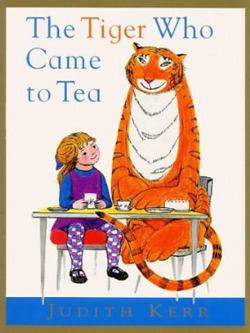
What makes stories like 'Winnie the Pooh' so timeless? What makes us tear-up when we start flipping through these books again as adults? Like what I mentioned above, there are many adult themes in children's books, most of them seem hidden to a child. And that is the magic of it all! A Senior Lecturer at the University of Roehampton's National Centre of Research for Children's Literature (there is such a research centre, wow!), Dr Alison Waller said, "I don’t think you can ever dig too deeply for meaning." She applies psychoanalytical theory to a story by Judith Kerr, 'The Tiger Who Came to Tea' (not many Malaysians are familiar to this one) in her favorite class activity which results in psychoanalytical interpretations of the tiger and his relationship with his family. Dr Alison Waller said that it is a very simple story but simplicity is not the same as lack of depth. "Just because we might not be aware of such adult messages when we read books as kids, doesn't mean we aren't absorbing them," she said. "However far this kind of 'message' seems to leap out at the adult reader, it is probably closer to the truth to say that the message has always been there but the knowledge that allows it to be recognized has not." What she means is that, such dark and complex themes have always been incorporated into children's books and only as adults we begin to see them clearer.
"Unfortunately, I realized that I am now so embarrassed to pick up books I used to enjoy so much because I feel I am older, more mature and I've outgrown it."
According to Dr Sheldon Cashdan, a professor of psychology at the University of Massachusetts, children's books have a lot to offer adults. He explains in his book 'The Witch Must Die: The Hidden Meaning of Fairy Tales', that these stories enable children to see the struggle between good versus evil which is a struggle that they feel within themselves acted out on the page. Dr Sheldon Cashdan said that these battles persist throughout life. “Notions of greed, of wanting more than you actually need – you can see this in the bonuses of hedge fund managers and [people who have] houses with five bathrooms. Or the subtle, maybe not so subtle, ways that people lie – dating and telling things that aren’t exactly true, fudging their income tax returns,” Dr Sheldon said. He said that it’s only as adults that we make the mistake of thinking that children’s literature, along with fairy tales, is essentially escapist. "When we pick these books up decades later, we’re surprised to learn what we doubtless always sensed as kids, even if we lacked the vocabulary to articulate it: that these stories are about eternal human strengths and weaknesses, about how to exist in the world," he said.
We have people like Ruth Graham who openly criticized YA readers in her 2014 Slate article saying that "...you should feel embarrassed when what you’re reading was written for children." And of course we have people like Non Pratt who got offended and expressed her opinions on her The Guardian post. I think, instead we can ask this simple question to ourselves and our fellow readers:
What is your purpose for reading? Be aware that everyone has a different purpose. Some of us want to improve our English or any other language; some of us want to relate to something; some of us want to expand our general knowledge; some of us just want our imagination to run wild. Identify your purpose for reading and be open to differences.
Then again, I would still be a little embarrassed if I were to pick up a 'Geronimo Stilton' or an Enid Blyton book. I've been so engrossed into crime fiction lately and I've grown to love this genre very much. Some of you might know, Agatha Christie is my absolute favorite crime writer and I plan to expand my collection of her books. Her books have only been outsold by the Bible and Shakespeare. Am I ignoring the childish side of me that wants to read a 'Geronimo Stilton' book? Maybe yes. Maybe when I have children in the future, I might get the right excuse to buy a children's book. For me now, crime fiction all the way! It doesn't matter what book you read or what genre or what age group, if you love it, then a book can transport you to many places and you are able to live many lives for as long as you read. 'Til the next post!
MY.
References
Anderson H. (2014). BBC-Culture. The hidden messages in children's books. Retrieved from http://www.bbc.com/culture/story/20140318-hidden-messages-in-kids-books
The Perfectionist (2011). Wassup, Doc? Mental disorders demonstrated by Winnie the Pooh characters [Web Blog Post]. Retrieved from https://wassupdoc.wordpress.com/2011/03/08/mental-disorders-demonstrated-by-winnie-the-pooh-characters/
Graham R. (2014). Slate.com. Against YA: Adults should be embarrassed to read children's books. Retrieved from http://www.slate.com/articles/arts/books/2014/06/against_ya_adults_should_be_embarrassed_to_read_children_s_books.html
Pratt D. (2014). The Guardian. Why adults shouldn't be embarrassed to read children's books. Retrieved from http://www.theguardian.com/childrens-books-site/2014/jun/10/adults-reading-ya-kids-teen-fiction-non-pratt

No comments:
Post a Comment
Thanks for your comment! ❤️