
"We're only human".
A well-known nonchalant saying often used to describe people as vulnerable and breakable; to resign to one's fate. That we are not above gods and we cannot control things or others. We do not have supernatural powers. We fall and bleed. We get our hearts broken. We get tired if we run too long or too fast. We get disappointed.
But what if being human is what makes us powerful? Although we may not have powers to bring back the dead, we are able to heal people through prayer and talk. We are able to bring back the dead by relieving memories. We are able to comfort ourselves by crying. We are able to heal our bodies by resting. It might seem very simple. But our human bodies are able to perform very extraordinary tasks daily to keep ourselves going.
Being only human is power itself. Let's rediscover 3 healing powers within us.
The Power of Crying
Humans are born with an innate set of emotional responses. Newborns automatically cry in pain or smile when in pleasure. They are not taught those emotions. Crying especially during infancy is a way for infants to grab the attention of the parents as they are unable to verbally communicate what they need. Infants cry when hungry; cry when they need to empty their bowels; cry when they are startled. Humans also experience other strong emotions such as love, grief, sympathy/empathy, appreciation of beauty and as a response, we cry. Crying is one of the most basic display of emotion in humans and yet we've learned to become so ashamed of it.
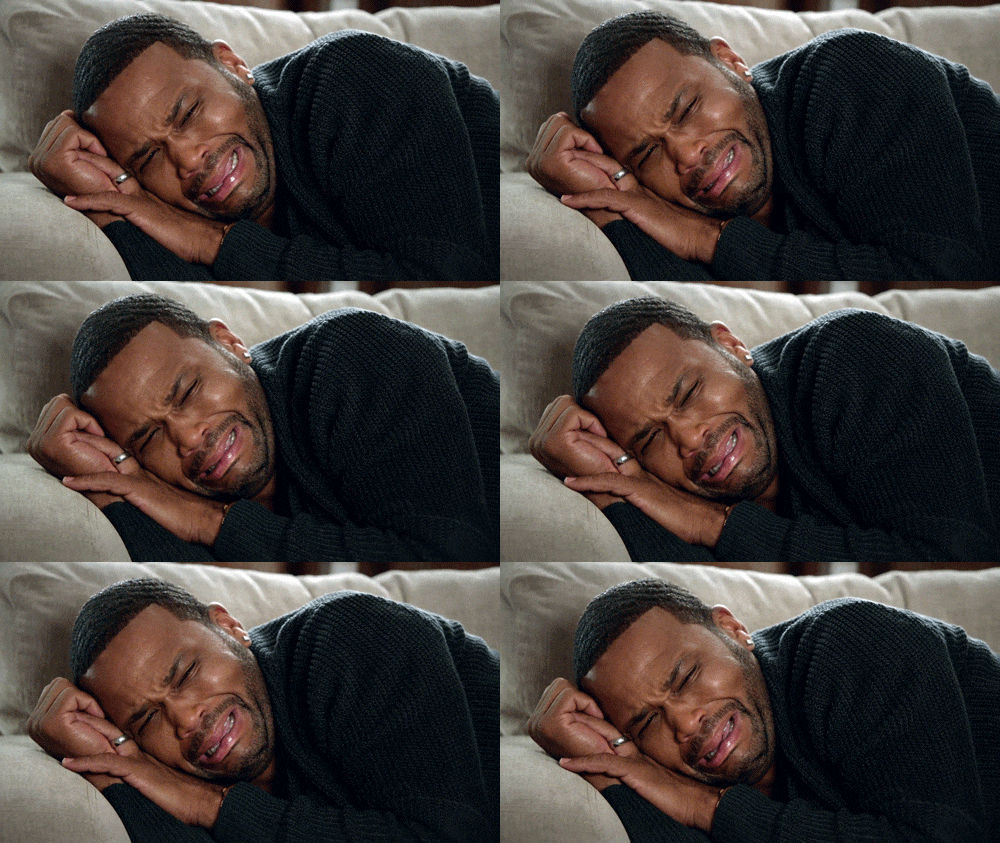 |
| GIF from GIPHY |
For centuries, no one could agree on why humans cry and where tears come from. In 1662, a Danish scientist by the name of Niels Stensen finally discovered that tears come from the lacrimal gland of the human eye. In 1982, Jane Brody wrote in her New York Times article about her interview with a biochemist and director of the St. Paul-Ramsey Medical Center of Psychiatry Research Laboratories named Dr. William H. Frey, who explained that:
"crying is an exocrine process,'' and "that is, a process in which a substance comes out of the body. Other exocrine processes, like exhaling, urinating, defecating and sweating, release toxic substances from the body. There's every reason to think crying does the same, releasing chemicals that the body produces in response to stress."
This process is described as an intra-individual function of crying which refer to the effects that crying has for the crying individual him/herself. In a way, crying is to self-soothe and to calm oneself which leads to reduction in stress and mood alleviation. See, the generation of emotions and the experience of emotions is processed in the cute part of the brain called the amygdala. I mean cute, as in small. The vital learning of emotional associations and recognizing emotional expressions is connected to the normal functioning of the amygdala. Damage to the amygdala may cause individuals to be unable to accurately judge other's emotional states by looking at their faces. The amygdala controls the autonomic nervous system (ANS) that cause physiological changes in our body. The ANS is divided into two: the sympathetic nervous system (SNS) and the parasympathetic nervous system (PNS). Emotions can activate either of these two systems. Picture this: a kid experiences a roller-coaster for the first time and begins to cry after the ride is over. The SNS is triggered, and the kid's heart rate accelerates during the ride and the hands turn sweaty as he tries his best to grab on to the handle. As the ride reaches the end, PNS is connected to the lacrimal glands and when the PNS receptors are activated by a neurotransmitter, it results in tear production. The body's heart rate slows down and somehow he feels a sense of relief after his crying episode.
Crying can also influence the behavior of people around us which is categorized as inter-individual function of crying. Based on the attachment theory, babies cry to elicit attention of a caregiver and bring them closer. Crying can promote empathy and facilitate bonding among people close to you. Many people find it easier to cry in front of close friends, spouses or family members as opposed to total strangers. Interestingly, crying in response to sadness or overwhelming happiness is one of the emotions used as a marketing strategy to influence consumer behavior. This is especially common during the holiday season. In Malaysia, advertisements that pull at the heartstrings are most common during Hari Raya, Chinese New Year and Independence Day (Merdeka Sales). Advertisements depicting estranged children coming home crying to their aging parents during the festive season using technology or over a bowl of rice really evokes a heartwarming emotion and a sense of belonging when consumers decide to buy a certain product. Companies know that consumers make choices emotionally rather than rationally during the festive season and they capitalize on that.
The Power of Believing
Humans are wired to believe, whether in something bigger than ourselves or to question the meaning of life like in religion or whether a person is dangerous and cause harm like prejudices to a certain group of individuals. Peter Halligan, a psychologist at Cardiff University describes a belief as a "mental architecture of how we interpret the world". Memories and experience from day-to-day learning create beliefs. Humans believe in a lot of things, for example an apple is red and there is a heaven. Humans may not believe in the same things but we individually or collectively have a set of belief systems that we rely on daily. When we believe in something, we take it as a truth.
 |
| GIF from GIPHY |
Although, spirituality is a concept unique only to humans, we might assume that having religious faith or believing in God is different from believing that Barack Obama was the 44th US President. We might think that having faith causes different brain activities or when we pray, a certain part of the brain lights up during an MRI scan. However, to the surprise of researchers at the University of California, LA, brain activity appeared in the same area of the brain for subjects who were devout Christians and non-believers when they believed a statement is true. That area is the ventromedial prefrontal cortex associated with rewards, emotions and self-representation. They were asked to answer a series of 'true or false' religious and non-religious statements such as "Angels do exist" or "Alexander the Great was a very famous military ruler". This finding proves that deciding whether something is true or false is not subject to the content of the statement, which then further proves that all types of belief are the same. Belief can be a powerful thing.
One example of the healing power of beliefs is the placebo effect. The placebo effect is an occurrence in improvement as a result of a participant's knowledge and expectations. A placebo is an inert treatment that produces benefits because the person receiving the treatment believes it to be beneficial. It is like giving someone a sugar pill but telling them that it is an analgesic, and the pain might actually go away. A significant study demonstrating the powerful nature of belief involved the “placebo brain surgery”. The research showed that patients with advanced Parkinson’s Disease who underwent a form of placebo or "fake" brain surgery which supposedly involves the transplantation of human embryonic dopamine neurons into their brains showed greater symptom improvements than those patients who did receive the actual transplant.
 |
| Photo by Sarah Pflug from Burst |
Belief in religion and having spirituality can also bring us health and heal those who are suffering according to certain experts. Personally, I have met patients (as I work in a hospital) who have told me "God will show me the way" or "there is a reason for the things happening in my life now". I feel that people want to believe in something when they are suffering or to give meaning to their suffering, and somehow that helps them cope better. Victor Frankl, a psychiatrist who told of his experiences in a Nazi concentration camp, wrote in his book "Man's Search for Meaning":
"A bit later, I remember it seemed to me that I would die in the near future. In this critical situation, however, my concern was different from that of most of my comrades. Their question was, "Will we survive the camp? For, if not all this suffering has no meaning". The question which beset me was, "Has all this suffering, this dying around us, a meaning? For, if not, then ultimately there is no meaning to survival; for a life whose meaning depends upon such a happenstance—as whether one escapes or not—ultimately would not be worth living at all."
Beliefs could be healing and provide stability or in reverse, could be damaging and cause chaos to the world. Therefore, as Uncle Ben said "With great power, comes great responsibility".
The Power of Sleeping
You're burning the midnight oil for a big test tomorrow and decide not to sleep. You try to control that yawn and fight the urge to close your eyelids. Whether you feel it or not, your brain has already started to function slower as usual. You try your best to cram weeks of material into those few hours - but it just won't go in anymore. You start to doze off - your head starts to sway side to side and somehow you keep rereading the same line. At 9AM the following day, you slam your head right into the test paper and startle the whole hall.
Sleep is just as important as food, water and sex for the survival of all living things. Humans sleep everyday (hopefully). Sleep experts say 7 to 9 hours of sleep is the optimum time for adults where else, babies and infants require as much as 12 to 17 hours of sleep. Experts also say short 10 to 20 minute power naps help you concentrate better and aids in memory. But why do we really sleep? Researchers are unable to give a unified answer however, decades of experiments and research have proven that sleep is a factor contributing to improved health and functioning.
In 2002, Harvard Medical School researchers published their findings on sleep's effects on procedural memory for motor skills. All the subjects were right-handed and were asked to perform the "sequential finger tapping task", that is typing a sequence of numbers with their left hand as quickly and as accurately as they could. Subjects showed overall similar improvement in their accuracy by 60% across 12 minutes of training, regardless of their time of training. When subjects who learned the sequence in the morning were retested 12 hours later, they showed less than 5% improvement. However, those who learned the sequence in the evening and were retested following a night's sleep, were 20% faster and more accurate. This study has demonstrated that sleep has just as a significant impact on motor skill learning than pure practice.
 |
| GIF from GIPHY |
Sleep has also effects on our brain function and overall health. Our brains basically run on "brain juice", which is glucose. Research data suggests that sleep deprivation-induced decrements in performance are accompanied by decreases in brain glucose metabolism, particularly in the prefrontal cortex which most likely results in risky behavior. Research has also shown that sleep affects how a body reacts to insulin, which is the hormone that controls blood glucose (sugar) level. The study reported that after 3 nights of experimental suppression of non-REM sleep, there was a decrease of insulin sensitivity of 25% which was close to the level reported for people who are at high risk for diabetes. Therefore, lack of sleep results in a higher than normal blood sugar level, which in turn may increase a person's risk for diabetes.
Safe to say, we sleep merely because our brains and bodies need a break. So, take that break. Sleep is our bodies' natural superpower mechanism.
Our Power
For millions of years, we've looked high into the clouds and far across the seas to look for miracle tonics to solve our problems and answers as to why we are mortal. It is true that we are breakable, but everyday our bodies and minds do something very incredible and miraculous. We build our selves up again, until a certain limit of course, but nevertheless we continue building. We build others, we build families and we build communities. We take a lot of things for granted, like our sleep, our belief and our ability to feel hurt. As we go further and further into the clouds and across the seas to feel more power and conquer the world, we try to forget what makes us human – we forget what makes us powerful.
Thanks for reading and Happy 1st of November!
MY.
References
Bernstein, D. A., Clarke-Stewart, A., Penner, L. A. & Roy, E. J. (January 1, 2011). Psychology. (9th ed.). Wadsworth Publishing.
Bond, A. (March 1, 2010). Belief in the Brain: Sacred and secular ideas engage identical areas. Scientific American. Retrieved from https://www.scientificamerican.com/article/belief-in-the-brain/
Casar Harris, R., Amanda Dew, M., Lee, A. et al. The role of religion in heart-transplant recipients' long-term health and well-being. J Relig Health 34, 17–32 (1995). https://doi.org/10.1007/BF02248635
Jha, A. (June 30, 2005). Where Belief is Born. The Guardian. Retrieved from https://www.theguardian.com/science/2005/jun/30/psychology.neuroscience
Killgore, William. (2015). Sleep Deprivation and Behavioral Risk-Taking. 10.1016/B978-0-12-420168-2.00030-2. Click here to download the PDF version of the article.
Kluger, J. (2009). The Biology of Belief. In Kluger, J. (Ed.) The Brain: A User's Guide (p. 122 - 127). Time Magazine.
McRae C, Cherin E, Yamazaki TG, et al. Effects of Perceived Treatment on Quality of Life and Medical Outcomes in a Double-blind Placebo Surgery Trial. Arch Gen Psychiatry. 2004;61(4):412–420. doi:10.1001/archpsyc.61.4.412 Click here to download the PDF version of the article.
National Heart, Lung and Blood Institute. (2020). Sleep Deprivation and Deficiency. Retrieved from https://www.nhlbi.nih.gov/health-topics/sleep-deprivation-and-deficiency#:~:text=Sleep%20deficiency%20is%20linked%20to,adults%2C%20teens%2C%20and%20children.
Oaklander, M. (March 16, 2016). The Science of Crying. Time. Retrieved from https://time.com/4254089/science-crying/
Strawbridge, W. J., Cohen, R. D., Shema, S. J., & Kaplan, G. A. (1997). Frequent attendance at religious services and mortality over 28 years. American journal of public health, 87(6), 957–961. https://doi.org/10.2105/ajph.87.6.957
Tasali, E., Leproult, R., Ehrmann, D. A., & Van Cauter, E. (2008). Slow-wave sleep and the risk of type 2 diabetes in humans. Proceedings of the National Academy of Sciences of the United States of America, 105(3), 1044–1049. https://doi.org/10.1073/pnas.0706446105. Click here to download the PDF version of the article.
Walker, M. P., Brakefield, T., Morgan, A., Hobson, J. A., & Stickgold, R. (2002). Practice with sleep makes perfect: sleep-dependent motor skill learning. Neuron, 35(1), 205–211. https://doi.org/10.1016/s0896-6273(02)00746-8. Click here to download PDF version of article.
Wright, L. (December 16, 2015). From tears to profit: How brands manipulate your emotions to increase holiday sales. CBC News. Retrieved from https://www.cbc.ca/news/business/online-holiday-marketing-1.3355669

No comments:
Post a Comment
Thanks for your comment! ❤️